THE ALPS · CANTON APPENZELL · TRAVEL GUIDE
A wooden guesthouse pressed into a cliff. How to get there, what to expect, and why this place still delivers.
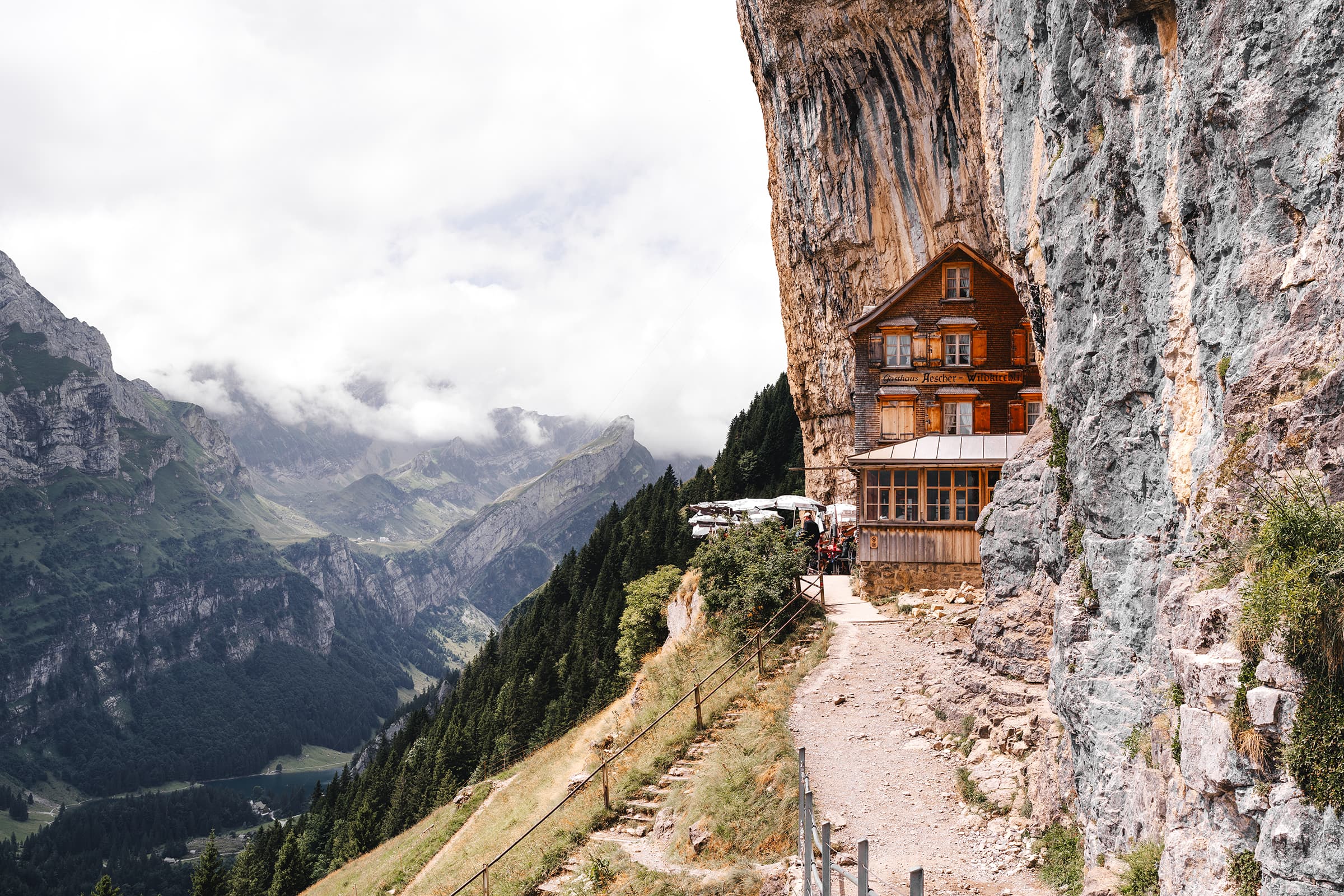
There is a photograph that has circled the internet more times than anyone can count: a timber house wedged between a limestone overhang and a sheer Alpine drop, looking less like something built than something that fell there and decided to stay. That is Äscher. A mountain guesthouse in the Alpstein range, Canton Appenzell, eastern Switzerland. Built in 1846. Still open.
That a National Geographic cover made it famous explains the crowds easily enough. What is harder to explain is why the place still works — why, after two hundred thousand visitors a year, it has not curdled into a postcard of itself.
The answer, unexpectedly, is in the walk.
What It Is — and Why Äscher and Wildkirchli Are Not the Same Thing
First, a correction that matters: Äscher and Wildkirchli are not the same place, though they are routinely confused. Wildkirchli is the caves, chapel, and cluster of historic cliff-face structures a little further up the same route. Äscher is the guesthouse and restaurant that follows. One cliff, two places.
The distinction matters because the visit is a sequence, not a destination. Cable car. Descent. Caves. Chapel. A narrow rock ledge of a path. And then — only then — the inn itself, appearing around the final bend at exactly the right moment.
One of the turns that changes everything is the entrance to the Wildkirchli caves. Outside: a bright Alpine afternoon. Inside: darkness, dripping limestone, cool air, and roughly 40,000 years of history — Neanderthal remains were found here in the 1800s.
The caves are not large and require no special equipment — a phone torch is enough. But they shift the texture of the walk in a way that a straight path to the guesthouse never could. Äscher lands differently after them.
Getting There: Route and Logistics
The route is straightforward:
Train to Wasserauen → cable car to Ebenalp (6 minutes) → walk down through Wildkirchli → Äscher (15–20 minutes on foot).
One detail that catches people out: after the cable car, the route goes downhill. The return journey goes back up. Neither is strenuous, but the climb takes more time than it looks. The last cable car does not negotiate, and Swiss timetables are not suggestions.
From Zurich, the journey to Wasserauen takes roughly ninety minutes by train, with a change at Gossau or Appenzell. The railway deposits you two minutes from the cable car station.
Cable Car: Wasserauen – Ebenalp
| Season | May – November (closed for maintenance in April and December) |
| Operating hours (summer) | 7:30 – 19:00 (July–August); 8:00 – 17:30 (May–June, September–November) |
| Frequency | Every 15 minutes |
| Return ticket | CHF 36 (adult) / CHF 18 with Halbtax or Swiss Pass / CHF 15 children aged 6–15 |
| Single ticket | CHF 24 adult / CHF 10 children aged 6–15 |
| Booking | No reservation needed — tickets at the station |
Guesthouse and Restaurant Äscher
| Restaurant season | Early May through late October / November |
| Table reservations | Not accepted for individuals or small groups — first come, first seated. Groups of 10+ can book for morning or evening slots (not between 9:00 and 16:00) |
| Overnight stays | Several room types from double to dormitory. Bookings open 1 February for the current season — the best dates go quickly |
| Website | aescher.ch |
If an overnight stay is on your mind, plan early. By March, the good dates are typically gone.
When to Go — and How to Read the Light
For a straightforward visit, any clear day in season works well. For photography, the answer is more specific: late morning to around midday. That is when direct light catches the timber facade and the pale cliff above it. Later in the day, the building falls into shade — still atmospheric, but different.
Summer weekends are the busiest. A weekday visit, or arriving early in the morning, means a quieter terrace and cleaner frames. The restaurant operates on a walk-in basis for small groups, so an early start pays twice.
Photography: What Actually Works
The most useful focal length here is 24mm on a full-frame sensor. It gives enough room for the inn, the overhanging cliff, and the valley behind — without reducing the building to a detail in a landscape. On a zoom, a 16–35mm range covers everything; 35mm produces a calmer, less obviously wide composition.
Shoot in RAW. The contrast between bright sky and deep shadow under the overhang is steep, and only a raw file gives you enough latitude to handle it in post. A tripod is not needed outside — it only earns its weight inside the caves.
The classic view opens at the last bend in the path, where the house, cliff, and slope converge in a single frame. Everyone with a camera knows this spot. Wait, and a clear foreground is genuinely possible.
What You Find When You Arrive
Äscher is not lonely and it is not quiet. There is a terrace, a restaurant, a small souvenir presence, and a steady flow of people who have also seen the photograph. Accepting this is part of the terms.
What works in its favour is that the place is still functioning — not preserved. Food comes out of the kitchen all day. Local beer is on tap. The back wall of the far dining room is bare rock. All of this together produces something that more polished destinations rarely manage: the feeling that a place is lived in rather than performed.
Do not expect solitude. Do expect atmosphere.
Practical Notes
Footwear. Shoes with grip. The cave sections can be slippery after rain, and the path is mountain terrain. Flat-soled city trainers are worse here than they look.
Torch. Your phone’s flashlight is enough for the caves.
Time. Build in a buffer. An early start earns better light, a quieter terrace, and a relaxed return to the last cable car.
Swiss Travel Pass / Halbtax. Both give 50% off the cable car. If you are travelling Switzerland for more than three days, this is a meaningful saving.
Cash. Cards are accepted, but on the mountain, having CHF on you is always the safer call.
Is It Worth Going — and What Makes It Different
Switzerland has no shortage of mountain set-pieces. There are wilder places, quieter places, places that have not yet appeared on anyone’s algorithm. Äscher is not competing on any of those terms.
What it offers is rarer: a famous place that holds up in person. The photograph gives you the geometry — timber, limestone, air. What it cannot give you is the smell of the cave, the cold of the overhang’s shadow on a July afternoon, or the particular way the guesthouse appears around that last bend — expected and surprising at the same time.
Come with decent boots, time to spare, and expectations set somewhere between wonder and realism. Äscher will meet you there.